Lately I’ve been trying to find some good rustic sounds for a personal project, and I ended up doing lots of research on ancient musical instruments. More specifically, I’ve been falling in love with the sound of ancient instruments straight from the ancient land between the rivers, and I wanted to share some videos with you.
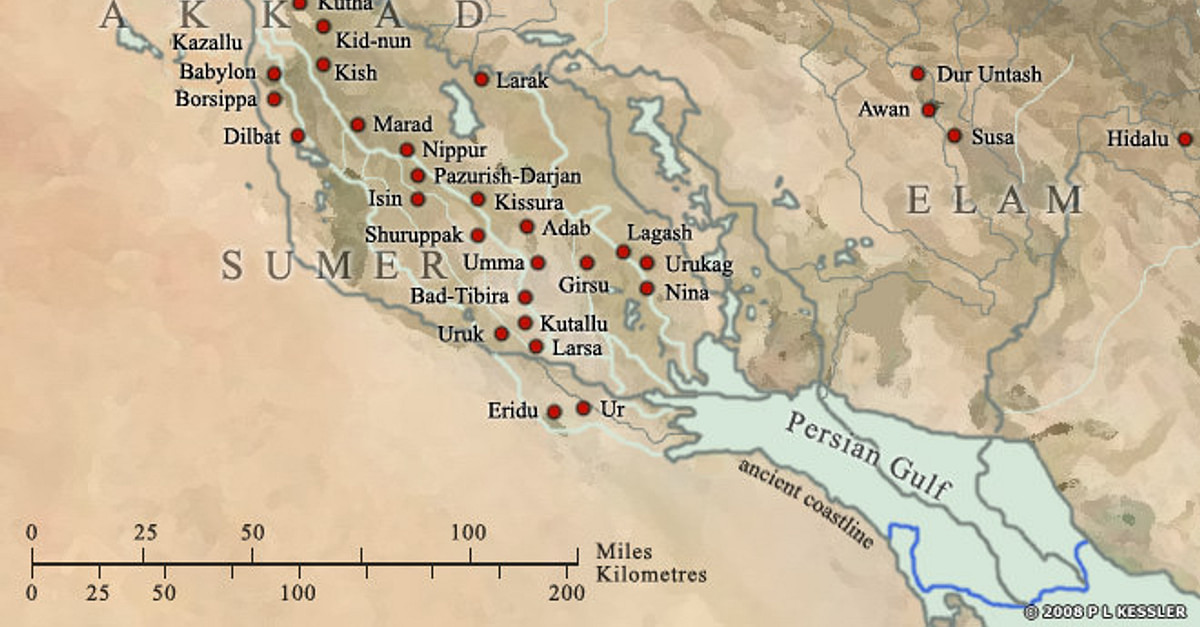
This lyre is a replica of a 4700 year old one found in the Sumerian city of Ur, apparently one of two such replicas to exist in the world today. It amazes me to think that, in a culture so ancient, they were able to design and perfect such sophisticated instruments with such a spiritual sound.
This video, performed in the courtyard of King Nebuchadnezzar’s palace in the land that was once called Babylon, is meant to give a good approximation of how music would have sounded in ancient Mesopotamia. It amazes me because the singer, somehow, is singing the first lines of the Epic of Gilgamesh in its original Sumerian.
The Sumerian language, which was distinct from the Semitic languages of the neighboring lands, was highly influential in its time, particularly for having the distinction of being the world’s first written language. Long after the decline of Sumer, the civilization’s advancements in science, philosophy, and writing caused Sumerian to maintain a status as a language of scholars, much like how Latin is treated today. But it has been a dead language for millennia, so no one knows for sure how it sounded since no one alive has ever heard it in its authentic form.
Not only were the Sumerians known for having among the earliest advancements in writing, astronomy, mathematics, wheeled vehicles, and a pantheon of gods that heavily influenced the beliefs and philosophy of our modern-day Abrahamic religions, but they had many instruments made with such an exquisite craftsmanship that I can only imagine was far ahead of their time. And this is only scratching the surface; who knows what other musical secrets have been lost to time.
I spent some time in the Northern Territory of Australia, specifically the Ayer’s Rock/Uluru area. This land is traditionally and currently owned by the Anangu people, whom it is believed have inhabited the area for over forty thousand years! That’s almost four times longer than when indigenous people of the Americas first arrived from Siberia. Like many Aboriginal tribes, the Anangu are considered among the oldest continuous human cultures on the planet, and while they no longer exist as nomadic hunter-gatherers as they once did, to this day their culture and language are very much alive.
Anangu people, photo from https://www.australiansky.co.uk/northern-territory-red-centre-holidays/uluru-ayers-rock
For decades the land was a national park by the name of Ayer’s Rock (Uluru is the traditional name for the mountain that is held sacred to the Anangu). Naturally, the Anangu people wanted the land back, for the mountains and the land itself is highly important to their culture, religion, and way of life. Because the land was now a national park and an icon of Australian national identity, the Australian government didn’t view as Anangu land, but everybody’s land, open to the public.
Eventually the two parties came to an agreement. In the 1980s, the Australian government returned the land to the Anangu, and the Anangu have signed a 99 year lease with the Australian government to keep the park open. In that spirit, everyone can come to the Uluru area and enjoy a scenery unlike anything else on Earth.
While I was at Uluru I met some of the Anangu people, and I paid attention to the language that they spoke. Their language is apparently a dialect of the Western Desert languages known as Pitjantijatjara. Interestingly, most of the Western Desert languages are largely mutually intelligible, almost like different dialects of a common language; for example the Pitjantijatjara language shares almost 80 percent of its vocabulary with the Yankunytjatjara language of South Australia. Many of the signs around the Anangu cultural center at Uluru were written in both English and Pitjantijatara. Some examples of vocabulary I picked up from these signs are wati, meaning man; minyma, meaning woman; kapi, meaning water; and wiya, meaning no.
The Pitjantijatjara language uses case marking to determine the role a noun plays in a sentence, which is common to many languages. The language also inflects verbs for tense, like English and other European languages, and it has four different classes of verbs that takes different endings. Sentences in Pitjantijatjara use the subject-object-verb order, unlike English which uses the subject-verb-object order.
Here’s an example from Wikipedia:
Minyma-ngku tjitji nya-ngu.
The first word means “woman” in the ergative case (subject of a transitive verb), the second word means “child” in the absolutive case (object of a transitive verb, in this context), and the third word means “see” in the past tense. This sentence translates to “The woman saw the child.”
However, when an intransitive verb is used, the subject of the sentence takes the absolutive case. For example:
Tjitiji a-nu.
The first word, as in the first example, means “child” in the absolutive case. The second word means “go” in the past tense. The sentence translates to “The child went.” As you can see, even though child is the subject of the sentence, it remains in the absolutive case. This is a common occurrence in languages that have an ergative-absolutive case dynamic.
When the subject of the sentence is a pronoun instead, it takes on the nominative case. For example:
Ngayu-lu tjitji nya-ngu.
The first word means “I” in the nominative case, the second word once again means “child” in the absolutive case, and the third word means “see” in the past tense. This sentence translates to “I saw the child.”
Uluru at sunset
While this post is mostly to bring attention to the ancient language of the Anangu people, it’s worth mentioning that I had a wonderful time out here in central Australia. I was traveling with a tour group and stayed at a resort hotel near the park for a few days – very different from the hostel-hopping lifestyle to which I have become accustomed. The Anangu people are friendly and are willing to share information about their way of life with the tourists, and many of them make their livelihoods selling artwork to travelers. However, as a travel advisory of sorts, they do not like it when tourists climb Uluru, and they also consider it rude to have photographs taken of them without their permission. Keep these things in mind should you decide to go out and see Uluru for yourself.
This is an important update to say that I will be expanding the focus of this blog. As my time in Australia is beginning to draw to a close, so too is to maintain this PURELY as a travel blog. But worry not! This does not mean that I will be ending my travels, nor does it mean that I won’t be writing about them. This does mean that I would like there to be more of a purpose to my travels and blogging.
I’ve had a long time passion for languages, as well as ancient folklore. As I mentioned in a previous blog post, I am on a journey to learn a lot of languages in my lifetime. I want to share that with you all, the many languages that exist in the world, as well as some of the techniques that I discover to learn them. In addition to that, I’m going to be talking about some of the obscure folklore of numerous cultures, preferably in conjunction to my discussion of languages. For every language I discuss, I’d like to discuss the ancient mythologies and beliefs that developed alongside the language. I have a lot to talk about!
In addition to that, I have recently received TESL certification and I am working as a freelance English tutor. As well as sharing with you the secrets of the languages I’m learning, I would like to share a lot about my own language as well. So I will be making blog posts that talk about my side gig as an English tutor, and some of my lesson plans on improving one’s English, although I’d be surprised if any of my readers didn’t speak English as a first language already.
For those of you that are thinking “Hey, Dalton, I don’t care about any of that. I just want to know where you are and what you’re doing!” Don’t worry. I’ll be talking about my travel experience too. I’ll make it clear in the blog title what the post is about. I’ll also categorize them, so you can access the different types of blog posts easier. So if you’re interested you can give it a read, and if not, you can give it a pass. No worries.
Years ago, I studied French in school and on my own, and I now am able to carry conversations entirely in French for over an hour. So I consider myself to be functionally conversant in French.
During my time in Australia I have met numerous Germans and, recalling that I wanted to learn German back in high school, have decided to tackle it head on. I learned hundreds of German in words in only a few months, and now I am able to have limited conversations in German. I have even acquired a decent understanding of the language’s unusual grammar that everyone told me was so difficult.
My goal is to become fluent in French and German, and to speak them as well as I speak my native English. But there are numerous other languages that I would love to learn as well; perhaps not to fluency, but to a basic, conversational, survival level. I compiled a list of languages that I have even a mild interest in learning, and decided I am going to see how much of them I can learn. There are over twenty-two languages on my list right now, including Spanish, Japanese, Welsh, Russian, Persian, and American Sign Language to name a few.
Can I really climb the Tower of Babel and learn so many languages? Well not at all at once. But given enough time, I absolutely believe that I can.
Why do I want to learn so many languages? Well during my time living among people from so many different lands and hearing so many different languages every day, I realize that learning languages is a way to connect to cultures and histories in ways that allow you to understand the nuances in a way no translation will ever allow you to do. I see learning languages as a sort of antithesis to racism, because in my experience, when you are able to understand the languages of foreigners, you quickly find that you have a lot more in common with them than what you have not.
Additionally, studies have shown that learning languages makes you sharper, able to use parts of your brain that you do not normally use, expressing yourself and your ideas with an entirely different set of vocabulary, which promotes new patterns of thought that you might not have previously had access to.
As some of you might know, I’ve been learning German during my time abroad. Well I’ve been working on a couple other languages as well. While German is my priority language, I’ve been improving my French with many of the francophones here in my Sydney hostel, and to a much lesser extent have been studying Spanish.
The thing about extended travel is that I have a lot of free time, and a lot of free mental energy. So I’ve decided to use as much of it as I can for self-improvement. And a big part of that self-improvement is rekindling the passion for languages that I had when I was younger.
So in an effort to bring new life to this travel blog, I am going to be telling you about my adventures in language learning as well as my traveling experiences. That way, even when I’m not traveling, I still have content that I can write passionately about.
As well as updating you on my progress in becoming fluent in these languages, I will also give you tips on how I learn. Some of these tips are things I have learned from polyglots that have proven to be effective. So if my blog ends up helping someone in their path to acquiring another language, or even inspiring someone to pick up another language to begin with, then that’s wonderful.


 Vagrant Bucket