Ancient Mesopotamian Music
Lately I’ve been trying to find some good rustic sounds for a personal project, and I ended up doing lots of research on ancient musical instruments. More specifically, I’ve been falling in love with the sound of ancient instruments straight from the ancient land between the rivers, and I wanted to share some videos with you.
This lyre is a replica of a 4700 year old one found in the Sumerian city of Ur, apparently one of two such replicas to exist in the world today. It amazes me to think that, in a culture so ancient, they were able to design and perfect such sophisticated instruments with such a spiritual sound.
This video, performed in the courtyard of King Nebuchadnezzar’s palace in the land that was once called Babylon, is meant to give a good approximation of how music would have sounded in ancient Mesopotamia. It amazes me because the singer, somehow, is singing the first lines of the Epic of Gilgamesh in its original Sumerian.
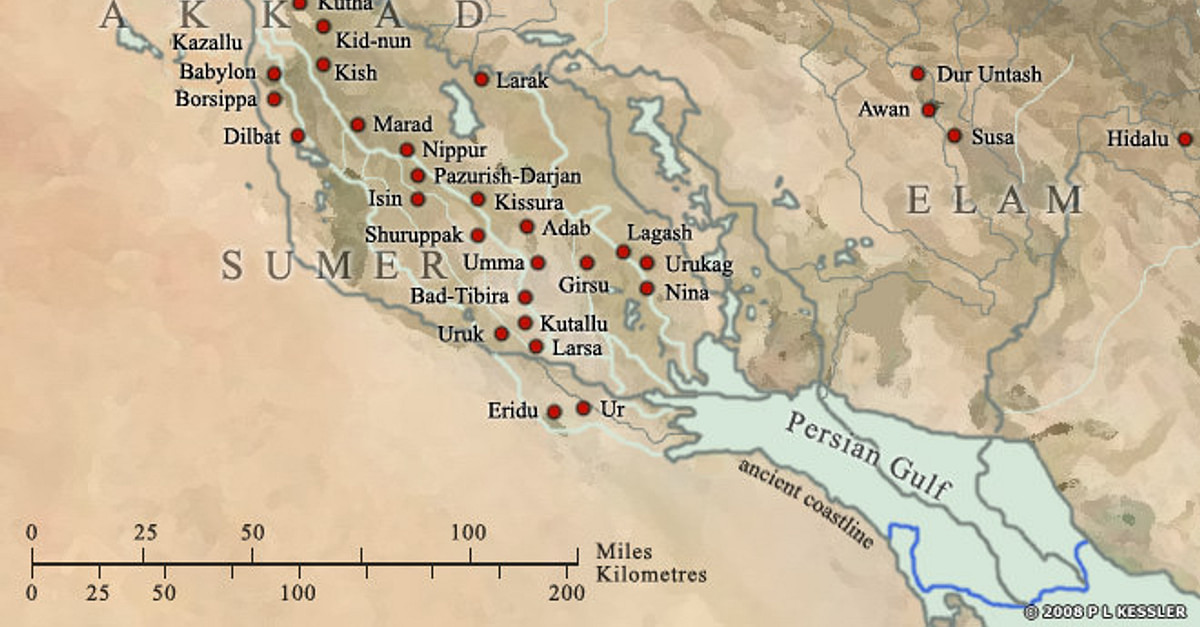
The Sumerian language, which was distinct from the Semitic languages of the neighboring lands, was highly influential in its time, particularly for having the distinction of being the world’s first written language. Long after the decline of Sumer, the civilization’s advancements in science, philosophy, and writing caused Sumerian to maintain a status as a language of scholars, much like how Latin is treated today. But it has been a dead language for millennia, so no one knows for sure how it sounded since no one alive has ever heard it in its authentic form.
Not only were the Sumerians known for having among the earliest advancements in writing, astronomy, mathematics, wheeled vehicles, and a pantheon of gods that heavily influenced the beliefs and philosophy of our modern-day Abrahamic religions, but they had many instruments made with such an exquisite craftsmanship that I can only imagine was far ahead of their time. And this is only scratching the surface; who knows what other musical secrets have been lost to time.
How it’s going
It’s been a bit since I’ve updated this blog and I figure I might as well let you know where I am.
I returned to America near the end of January, a little over a week before my visa in Australia expired. I returned with a sprained ankle after a surfing mishap on Bondi Beach involving me and some shallow water, an injury from which I have since recovered completely. But I didn’t let that keep my spirits down. I want to thank you for following my travels in Australia. I had a wonderful time and I would like to return, sooner rather than later.
But as you probably could have guessed, my travel plans have been postponed for some time in the midst of this global pandemic. I’ve been staying home during the quarantine like a good lad and working on freelance programming projects, saving up some extra money for my next big trip. All in all things have been going quite well for me, and to whomever is reading this I hope that you can say the same.
I am very thankful for my time abroad and that I am safe right now.
Stay safe everyone.
Cairns and Me!
As part of a tour group with my mother, who was visiting me from abroad, I had the opportunity to visit the beautiful city of Cairns. A tropical paradise city often compared to Hawaii, Cairns is a tourist location in Queensland where visitors often take a boat out to the Great Barrier Reef.

The Great Barrier Reef is considered one of the great natural wonders of the world. In terms of size and beauty it is much like the Great Wall of China, but you know, natural, and, in the water.

I had the wonderful experience of snorkeling around the big, colorful corals, and I even went diving in a device called a “Scooba-Doo”, an underwater scooter of sorts with an attachment that resembled an old diving helmet, but made of yellow plastic. However it was less of a helmet and more of an air pocket that you stuck your head into before being submerged into the murky depths below. As you might imagine, it was terrifying for all of three seconds, then you started to get used to having your head crammed inside of a tiny air pocket.

Seeing the reef up close and personal like this was an amazing experience. Just don’t make the same mistake I did and almost have your glasses become a permanent addition to the reef itself. Fortunately a kind diver was able to recover them for me.
There is also the famous Night Market, which is probably famous for being a market, but at night. There you can fulfill all of your tourist-y needs in the form of more souvenirs than anyone could possibly need. A lot of the items are handcrafted too, of varying quality. One nice thing about Australia that I don’t believe I’ve mentioned before is that there are a lot of marketplaces where artisans and small businesses can sell their goods. There were also massage parlors that offered quick foot and back massages for very cheap.

I also recommend visiting the Wildlife Dome – a small enclosed zoo on top of a casino. Lots of birds and small animals call this place home, as well as a giant crocodile called Goliath, a half-ton creature that resided within a pit of murky water at the center of the enclosure. How they managed to get a creature almost the size of a car on top of a building like that is beyond me.


My apologies for the lack of photos of Goliath, but the big guy was sleepy and in the far corner of a dark tank of water. No photo would have captured the size of this creature, so you’ll just have to take my word for it. Or go there yourself and see.
And there is also the world famous Skyrail: a cable car system that runs from Cairns to the mountain village of Kuranda, traversing the Barron Gorge National Park and endless miles of mountains and rainforests. This is a must-do if you’re in Cairns, even if you are afraid of heights. During the production of James Cameron’s Avatar, he had his artists ride this cable car to find inspiration for the setting of the movie itself.

The gorge itself is absolutely stunning. A breathtaking waterfall flows far into the gorge below. We visited during the dry season, but during the wet season the waterfall is even more spectacular to behold! (not pictured here)


I was only in the city for a few days, though I wish I could have stayed much longer. This will definitely be a place I visit next time I return to Australia.
The Anangu Language
I spent some time in the Northern Territory of Australia, specifically the Ayer’s Rock/Uluru area. This land is traditionally and currently owned by the Anangu people, whom it is believed have inhabited the area for over forty thousand years! That’s almost four times longer than when indigenous people of the Americas first arrived from Siberia. Like many Aboriginal tribes, the Anangu are considered among the oldest continuous human cultures on the planet, and while they no longer exist as nomadic hunter-gatherers as they once did, to this day their culture and language are very much alive.

For decades the land was a national park by the name of Ayer’s Rock (Uluru is the traditional name for the mountain that is held sacred to the Anangu). Naturally, the Anangu people wanted the land back, for the mountains and the land itself is highly important to their culture, religion, and way of life. Because the land was now a national park and an icon of Australian national identity, the Australian government didn’t view as Anangu land, but everybody’s land, open to the public.
Eventually the two parties came to an agreement. In the 1980s, the Australian government returned the land to the Anangu, and the Anangu have signed a 99 year lease with the Australian government to keep the park open. In that spirit, everyone can come to the Uluru area and enjoy a scenery unlike anything else on Earth.
While I was at Uluru I met some of the Anangu people, and I paid attention to the language that they spoke. Their language is apparently a dialect of the Western Desert languages known as Pitjantijatjara. Interestingly, most of the Western Desert languages are largely mutually intelligible, almost like different dialects of a common language; for example the Pitjantijatjara language shares almost 80 percent of its vocabulary with the Yankunytjatjara language of South Australia. Many of the signs around the Anangu cultural center at Uluru were written in both English and Pitjantijatara. Some examples of vocabulary I picked up from these signs are wati, meaning man; minyma, meaning woman; kapi, meaning water; and wiya, meaning no.
The Pitjantijatjara language uses case marking to determine the role a noun plays in a sentence, which is common to many languages. The language also inflects verbs for tense, like English and other European languages, and it has four different classes of verbs that takes different endings. Sentences in Pitjantijatjara use the subject-object-verb order, unlike English which uses the subject-verb-object order.
Here’s an example from Wikipedia:
Minyma-ngku tjitji nya-ngu.
The first word means “woman” in the ergative case (subject of a transitive verb), the second word means “child” in the absolutive case (object of a transitive verb, in this context), and the third word means “see” in the past tense. This sentence translates to “The woman saw the child.”
However, when an intransitive verb is used, the subject of the sentence takes the absolutive case. For example:
Tjitiji a-nu.
The first word, as in the first example, means “child” in the absolutive case. The second word means “go” in the past tense. The sentence translates to “The child went.” As you can see, even though child is the subject of the sentence, it remains in the absolutive case. This is a common occurrence in languages that have an ergative-absolutive case dynamic.
When the subject of the sentence is a pronoun instead, it takes on the nominative case. For example:
Ngayu-lu tjitji nya-ngu.
The first word means “I” in the nominative case, the second word once again means “child” in the absolutive case, and the third word means “see” in the past tense. This sentence translates to “I saw the child.”

While this post is mostly to bring attention to the ancient language of the Anangu people, it’s worth mentioning that I had a wonderful time out here in central Australia. I was traveling with a tour group and stayed at a resort hotel near the park for a few days – very different from the hostel-hopping lifestyle to which I have become accustomed. The Anangu people are friendly and are willing to share information about their way of life with the tourists, and many of them make their livelihoods selling artwork to travelers. However, as a travel advisory of sorts, they do not like it when tourists climb Uluru, and they also consider it rude to have photographs taken of them without their permission. Keep these things in mind should you decide to go out and see Uluru for yourself.

The Future of Vagrant Bucket
This is an important update to say that I will be expanding the focus of this blog. As my time in Australia is beginning to draw to a close, so too is to maintain this PURELY as a travel blog. But worry not! This does not mean that I will be ending my travels, nor does it mean that I won’t be writing about them. This does mean that I would like there to be more of a purpose to my travels and blogging.
I’ve had a long time passion for languages, as well as ancient folklore. As I mentioned in a previous blog post, I am on a journey to learn a lot of languages in my lifetime. I want to share that with you all, the many languages that exist in the world, as well as some of the techniques that I discover to learn them. In addition to that, I’m going to be talking about some of the obscure folklore of numerous cultures, preferably in conjunction to my discussion of languages. For every language I discuss, I’d like to discuss the ancient mythologies and beliefs that developed alongside the language. I have a lot to talk about!
In addition to that, I have recently received TESL certification and I am working as a freelance English tutor. As well as sharing with you the secrets of the languages I’m learning, I would like to share a lot about my own language as well. So I will be making blog posts that talk about my side gig as an English tutor, and some of my lesson plans on improving one’s English, although I’d be surprised if any of my readers didn’t speak English as a first language already.
For those of you that are thinking “Hey, Dalton, I don’t care about any of that. I just want to know where you are and what you’re doing!” Don’t worry. I’ll be talking about my travel experience too. I’ll make it clear in the blog title what the post is about. I’ll also categorize them, so you can access the different types of blog posts easier. So if you’re interested you can give it a read, and if not, you can give it a pass. No worries.
Thanks for reading!
Australia’s Capital
I spent a quiet Halloween in the equally quiet city of Canberra. Smaller than my hometown, the capital of Australia doesn’t seem to have much going on when Parliament is not in session. But it’s a very pretty city, with lots of monuments and memorials and museums.
The city offers a service called the Culture Loop. It’s a free bus service that stops at all the major museums and government buildings every hour. From my hostel on London Circuit near City Hill. I used the bus to make my way across the river to the old government buildings.

The parliament building of Australia is very beautiful, known for its legendary metal arch with the Australian flag on top. The building is open to the public and offers guided tours. I chose to wander through the echoing marble halls alone. Inside I saw the great hall, various offices, and long corridors lined with portraits of prime ministers past.


There’s also the former parliament building, which has been converted to the Museum of Australian Democracy. The beautiful Magna Carta rose gardens are beside it, and the two Houses of Parliament are connected by a long lawn that serves to symbolically connect the early years of the Australian Commonwealth with its current regime.
While the buildings themselves are quite breathtaking in appearance and fun to explore, I must admit that this is a part of my travel that didn’t capture my interest so much. As a foreigner, I didn’t grow up learning about the Australian parliament and its prime ministers. But it is interesting to see how in the early 20th century, the lands of the British Empire slowly transitioned into a more democratic form of government.
From the capital building you can see across the lawns all the way to the ANZAC monument at the end of the city, and beyond that, beautiful Mt. Ainslie.

Additionally there is the American-Australian Memorial. This memorial is to commemorate the help provided by the Americans during the Second World War. At that time, Britain’s armies were quite overtaxed on the European war front, and Australia faced an imminent threat from the Japanese. That’s when the American fleet stepped in to boost their defenses. It’s a gorgeous monument, and admittedly seeing it made me long for my home country.


I also spent some time at the National Australian Museum and the neighboring Australian Indigenous Language Institute. There I learned a lot about the Ngunnawal country on which the capital city has been plopped on.As traditional custodians of the land, home and country is VERY important to the Aborigine people here, and they take a lot of pride in their lands, even when they no longer own them.


I learned that before the Europeans arrived, there were over 250 languages spoken on the continent. Today most of those languages are endangered. Whilst the Aboriginal communities here are alive and well, it’s becoming increasingly difficult to preserve the 40 thousand year old culture here, their language, and their way of life for the younger generations. I think it’s important to hang on to these cultures and these languages, to understand our ancestors and where we all come from.
In any case, the Aboriginal people are very significant to the Australian continent, and I will be writing about them a lot more in the future. There are some very important updates to my blog coming up, so look forward to those!


Traveling Again
After residing and working in Sydney for some time, I’m back on the road again. More specifically, I’m writing this from a bus en route to Canberra.

The nation’s capital, as I’ve heard, is a rather quiet city when Parliament is not in session. There’s a lot of history in this city, as well as lots of free museums, much like what I found in Melbourne.
I’ve been in one place for far too long, and I’m eager to start traveling once again. After this, I’ll be heading down to Melbourne to meet my mother, whom I haven’t seen in eight months.
And I look forward to writing more in this blog too.
Warming Up
It’s 3 in the morning and I can’t sleep. Which means it’s a perfect time for me to let you lovely folks know what I’ve been doing for the past couple months.
I still reside in beautiful Sydney, and I’ve become very accustomed to this place. Two of my favorite locations here are the Sydney Aquarium, which I visited with a dear friend, and the world-famous Bondi Beach, which I visited alone on a sunny weekend and plan to make many more visits to now that the weather is warming up.


Now you may been wondering “Dalton, where have you been? What have you been doing? We missed you!” Well, back in July I started taking improv comedy lessons, which has so far proved to be a very fun and social experience. I take beginner-level classes every Monday evening, and every Wednesday evening I watch the more advanced students perform on stage. It’s amazing to see just how in tune these actors are with each other, especially knowing that they’ve only been practicing improv for less than a year. None of them seem nervous on stage at all; they seem to be very comfortable with each other and performing in front of an audience.
I’m almost done with the first term of improv lessons, and I’m planning to move onto term 2 while I’m still here. I can’t say for sure what I plan to do with these improv lessons, but it’s a fun skill and I hope that I can use it to become a better writer and generally a more entertaining speaker.
I took a job at a call center for a charity organization. It’s a much more stable job than the warehouse jobs I was working during my last update, which I am very grateful for. Making ends meet has been a challenge, which requires a lot of time management skills and budgeting. I don’t want to go into detail on that, but I am optimistic that things will much better from here on.
I am still studying my languages every day. Lately I’ve been tackling Spanish and Esperanto, though admittedly I’ve been lagging behind in practice due to other priorities at the moment. As for my French and German, I find opportunities to practice with the European travelers that come through my hostel from time to time, so I’m not slipping behind in what I’ve already learned. As I said earlier, I plan to make this blog a lot more language oriented.
Until next time!
Update: Working in Sydney
Hey everyone, just wanted to let you know that I’ve been busy with working in Sydney the past few weeks. I work for a stage rental company that rents stages and curtains to public events, television filming sets, sports events, etc. Every few days I get a text from my boss to a location within in Sydney to help them set up or take down a stage. It’s a wonderful job that allows me to see parts of Sydney that I wouldn’t have otherwise gone to. My first day on the job I was asked to drive a massive truck through Sydney peak hour traffic – not something I would ever want to do again.
The only downside to my job is that the hours are not so great, so I’ve been searching for a second part time job as well as setting up a new budget for myself.
Additionally I have been trying out lots of new recipes. The new budget limits me to doing my grocery shopping at Aldis, and my new goal is to become highly proficient at cooking with inexpensive ingredients. I’m also attempting to cook and eat much healthier than I have been. I’ll share with you some of the new recipes I’ve been trying out in the future.
As for my language blog, I’ve still been working on that. This week I’ve been trying out the new Arabic lessons they’ve added on Duolingo, because I am curious to see how the language works and if Arabic is a lesson I would like to study in the future. Every week I go to an event called Sydney Lingo, an event I found through the Meetup app that enables language speakers and learners to meet up at different bars across town. I’ve made some new friends this way, and have seen new aspects of Sydney’s nightlife.
 Vagrant Bucket